Tesla BMS_f107 Isolation Fault: Why Your Car Won't Charge & How It Is Repaired
If your Tesla suddenly displays "BMS_f107: Electrical Isolation Fault - Car Cannot Charge", the vehicle's onboard safety system has detected a potential high-voltage leakage path to the chassis ground and locked charging for protection.
Service Center Diagnosis vs. Actual Component Failure
Tesla Service Centers do not open battery enclosures to reseal localized gaskets or replace single sensors; when isolation drops, they routinely prescribe complete pack replacement. In over 80% of real-world cases, the underlying culprit is simply moisture ingress around the pyrofuse header, a leaking internal coolant manifold gasket, or an isolation fault in the external PTC cabin/battery heater.
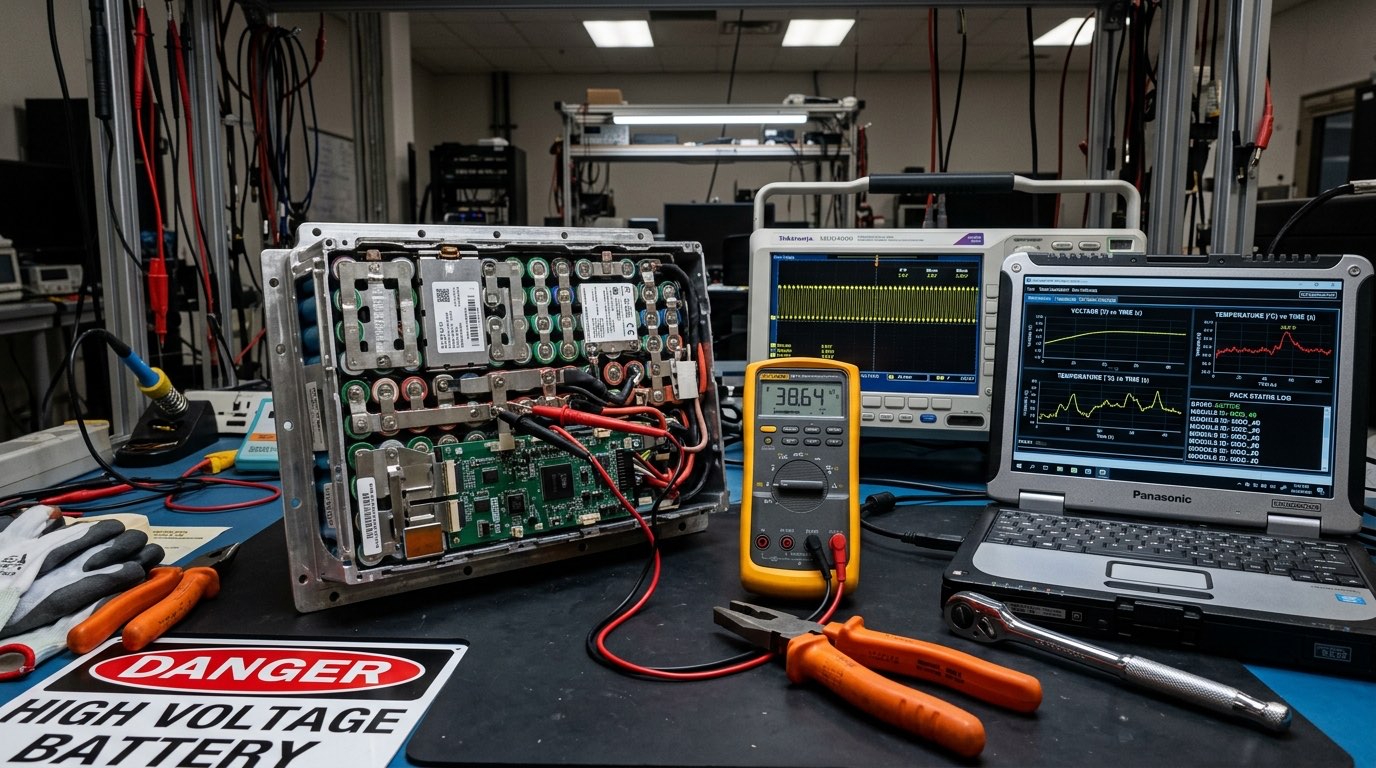
The 500k Ohm Isolation Threshold
The vehicle's chassis ground must remain galvanically isolated from the 400V battery circuit. On every startup cycle, the BMS injects a high-frequency pilot signal to measure insulation resistance. If moisture, coolant, or conductive dust causes insulation resistance to fall below 500k Ohms, the contactors immediately open.
Microscopic glycol coolant vapor condensing on aluminum cooling manifolds, reducing resistance to ground.
Moisture breaching the pyrotechnic fuse seal, causing galvanic bridging across the fuse terminals.
Internal ceramic element cracking in the high-voltage cabin heater, grounding HV into the coolant loop.
Frequently Asked Questions: BMS_f107
Can I clear the BMS_f107 code by disconnecting the 12V battery or rebooting the screen?
No. BMS_f107 is a hardware-level safety lockout. The BMS runs a dynamic real-time isolation test upon every boot sequence. Until the physical leakage path is isolated and insulation resistance exceeds 500k Ohms, the lockout remains.
Can this issue be repaired as a weekend DIY project?
No. 400V High Voltage carries lethal electrocution risks. Diagnosing isolation faults requires dropping the pack, utilizing a 1000V Megohmmeter insulation tester, and specialized hermetic resealing procedures. It must be performed by trained EV laboratory technicians.
Need BMS_f107 High-Voltage Isolation Repair?
Don't pay for a whole new pack from Tesla. Submit your Tesla model, year, and city and we will email you experienced independent EV battery specialists in your region.