Tesla DIY Tool Kit: What You Need (and What Not to Touch)
By the EV Fix Guide team · · 3 min read
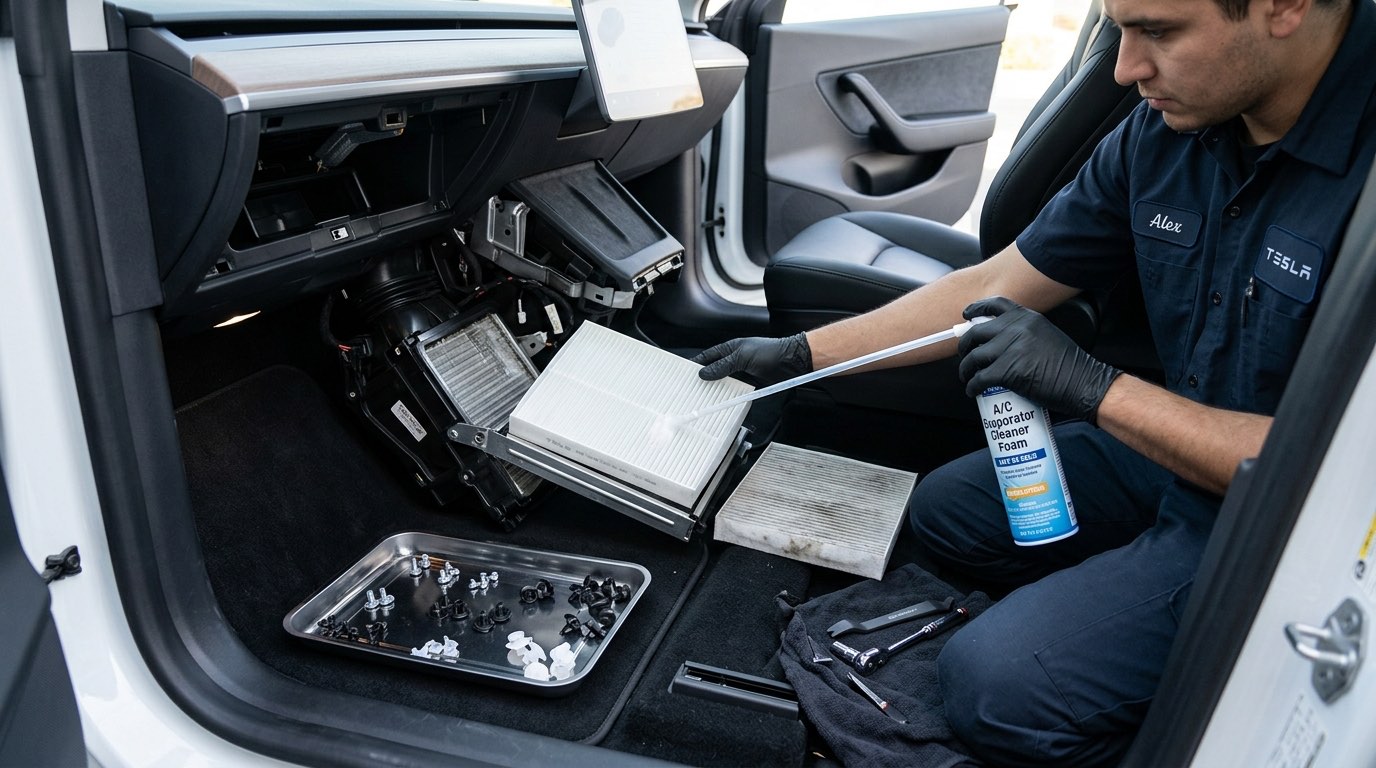
Many Tesla owners pay a service center for jobs they could do in the driveway in under an hour. Cabin filters, 12V batteries, wipers and trim clips all need only basic tools.
Here is the short tool list that covers most of those jobs, and the hard line on what stays with professionals.
In short
- A Torx and socket set, jack pads and plastic trim tools cover most DIY jobs.
- Always lift on jack pads, never directly on the battery pack.
- Orange cables carry 400–800V. Never cut, unplug or touch them.
- Battery modules, inverters and AC refrigerant are pro-only.
The four essentials
- Torx and socket set: Torx T20, T25 and T30 for interior trim, and 10 mm, 15 mm and 18 mm sockets for the 12V battery and suspension parts.
- Tesla jack pads (pucks): a set of four rubber pucks that slot into the lift points. They protect the high-voltage battery when you raise the car.
- Plastic trim tools: non-marring pry tools for under-dash panels, cabin filter covers and door cards, without breaking clips.
- A torque wrench: suspension and wheel bolts need the right torque. Guessing leads to squeaks or worse.
Jobs you can usually do yourself
With the kit above, these are realistic weekend jobs. Each guide lists time, difficulty and exact tools.
Never do these at home
Orange cables and components carry 400–800V. That voltage can kill. Keep home DIY to 12V low-voltage parts and mechanical components.
- High-voltage battery module replacement
- Inverter or high-voltage cable servicing
- AC refrigerant (R1234yf) recovery or recharge, which needs certified equipment
Tesla Model 3 fixes & recalls, by email
One email a month. New fixes, recalls, real prices. Free.
More owner repair stories
- Tesla Service Mode: How to Open It and What to RunThe hidden diagnostics menu every Tesla has, and the four tests worth running.
- How to Reset a Tesla: Soft Reset, Power Off and 12V RebootThree resets, from 15 seconds to 10 minutes. Start with the lightest one.
- Does an Independent Shop Void Your Tesla Warranty?Short answer: no. Here is what the law says and where the limits are.
- Tesla 12V / 16V Battery Warning: What Owners Replaced and What It CostA 10-minute DIY swap, $85 Tesla batteries, $122 mobile service, Ohmmu lithium warnings and why the newer 16V battery should not be replaced early.
This guide is for information only. High-voltage components (orange cables) can be lethal — leave them to trained technicians. Not affiliated with Tesla, Inc.