Model 3 & Y AC Smells Like Vinegar or Dirty Socks: How Owners Got Rid of It
By the EV Fix Guide team · · 3 min read
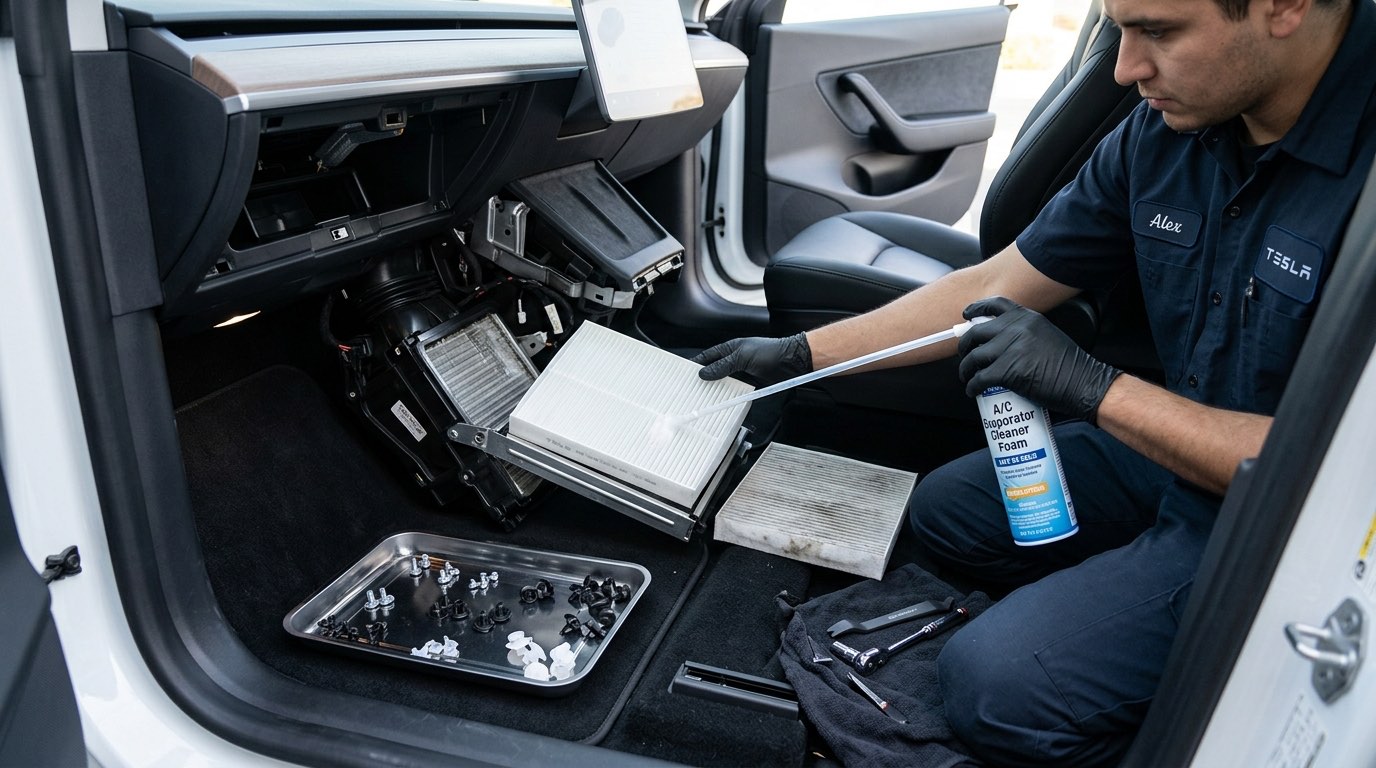
A sour, vinegar or dirty-sock smell for the first minute after switching on the A/C is one of the most common Model 3 and Model Y complaints. A Model Y owner noticed it only three months after delivery [3]; a UK Model 3 owner put up with it for up to a year [4].
The cause is almost always mildew on the damp evaporator coil rather than the filters themselves [1][5]. Here is how owners on Tesla Motors Club cleaned it, what it cost, and the habits that kept it from coming back.
What owners learned
- Foam the evaporator from the filter box with both filters out, not up the drain tube; the filters sit right in front of the coil [1][5].
- A can of foam (about $15) and a pair of filters (about $17) replaced a Tesla visit of about $135–150 [2][3].
- The smell often comes back within weeks to months in humid weather, so the fix needs repeating [2][4][5].
- Habits owners credit most: avoid recirculation and run the fan without A/C for the last minute or mile [2][5].
- No puddle under the car after A/C use can mean a blocked condensate drain [3].
The DIY clean that worked
A Model 3 owner followed Tesla’s DIY guide to remove both cabin air filters, which exposes the evaporator. He pushed the spray tube through a small foam shield, filled the coil with Nextzett Klima Cleaner (chosen because it foamed more than a cheaper can), waited about 15 minutes, ran the fan for a couple of minutes and reassembled. The smell was gone the next day [1]. Another member cured a Model S the same way with a 20-minute soak [1].
Other owners used Kool-It foam, some with two cans [2]. One practical warning from the threads: hold on to the filter cover screw, because it is easy to drop into the car [2].

Why the Lysol trick does not work on a Model 3
Spraying disinfectant into the cowl intake is a classic fix on other cars. On a Model 3, a member explained, the air passes through the filters before it reaches the evaporator, so most of the spray never gets to the coil [5]. Spraying evaporator cleaner directly into the coil through the filter access door kept the smell away for two to three months for that owner [5].
Another owner found mold on a one-month-old filter, on the side facing the evaporator, which is a good sign the coil itself was the source [5].
Why it comes back, and how owners kept it away
One owner fitted new filters and used Kool-It, and the smell was back in two to three weeks, mostly after long A/C use followed by fan-only [2]. Several others reported the same in humid summers [4][5].
The habits owners credit: avoid recirculation (one long-time owner said this kept three Teslas odor-free in a humid climate) [2]; switch the A/C off and run the fan for the last minute or mile before parking [5]; and run heat on HI with maximum fan for about 20 minutes to dry the system when the smell appears [3][4]. Tesla’s post-drive fan run, added in firmware, gave mixed results for owners [1][3].
Water can also get in from outside. Adam Davenport’s video shows rain reaching the cabin filters through the fresh-air intake at high fan speed, and suggests keeping the fan low in rain.

Paying Tesla instead
One member paid Tesla about $135 for a coil cleaning and regretted it after learning the foam costs about $15; another was quoted about $150 [2]. A mobile service estimate for cabin filters came to $144 with tax [3]. In the UK, owners cited about £57 for filters at Tesla and £169 for a two-year service including filters and wipers [4].
Warranty treatment varies: one service center called the smell not a warranty item, while another owner had the system cleaned under warranty [1][4].

What it cost owners
Full repair guide and cost table
Step-by-step fix, tools and Tesla vs independent shop vs DIY prices: Tesla AC Smell (Musty or Vinegar): How to Fix It.
Tesla Service $120 - $200 · independent shop $55 - $100 · DIY $18 - $35 (2x Activated Carbon/HEPA Filters + Foam Spray)
Sources: owner forum threads and references
- [1] AC odor removal and cleaning · Tesla Motors Club, Jun 2019Foaming the evaporator through the filter box with Nextzett Klima Cleaner.
- [2] Model 3 AC Smell Update... · Tesla Motors Club, Jul 2020Tesla price vs Kool-It DIY; recirculation habits.
- [3] Bad AC Smell · Tesla Motors Club, Jul 2020Model Y smell at three months; drain check; mobile service estimate.
- [4] Smelly HVAC · Tesla Motors Club, Sep 2022UK owner; filter and foam fix; UK prices.
- [5] Mold on bottom filter · Tesla Motors Club, Aug 2023Why cowl spraying fails on Model 3; prevention habits.
We summarise owner reports in our own words and link to the original threads; individual results vary. Videos belong to their creators and are embedded from YouTube.
Tesla Model 3 fixes & recalls, by email
One email a month. New fixes, recalls, real prices. Free.
More owner repair stories
- Tesla Service Mode: How to Open It and What to RunThe hidden diagnostics menu every Tesla has, and the four tests worth running.
- How to Reset a Tesla: Soft Reset, Power Off and 12V RebootThree resets, from 15 seconds to 10 minutes. Start with the lightest one.
- 4 Tesla Fixes Owners Swear By (Most Cost $0)Steering shake, dead 12V, AC smell and idle fees. Four shortcuts from owners.
- Tesla DIY Tool Kit: What You Need (and What Not to Touch)Torx set, jack pads, trim tools. And the jobs you should never do at home.
This guide is for information only. High-voltage components (orange cables) can be lethal — leave them to trained technicians. Not affiliated with Tesla, Inc.