Tesla Maintenance Schedule by Model: What and When
By the EV Fix Guide team · · 7 min read
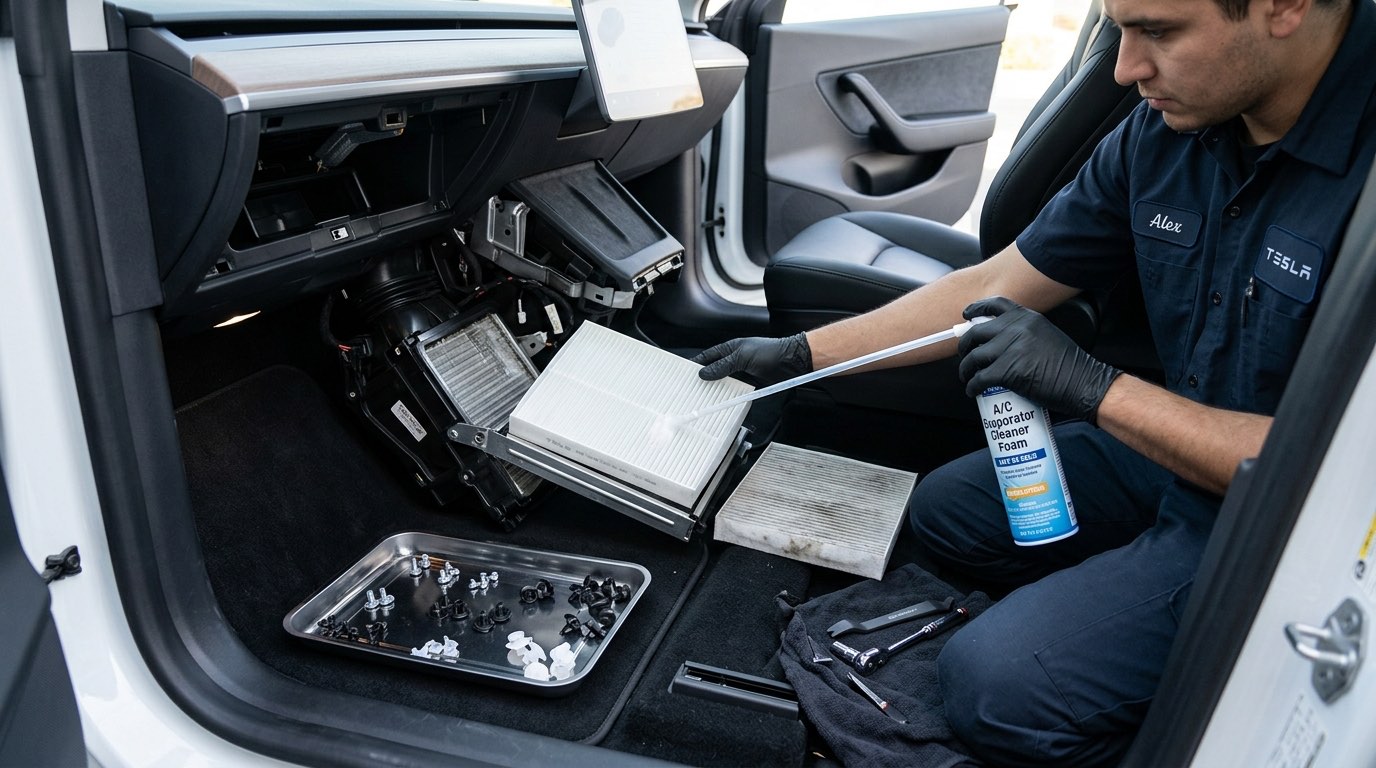
The Tesla maintenance schedule is short: Tesla’s Owner’s Manual recommends rotating tires every 6,250 miles, replacing the cabin air filter every 2 years (3 years on newer Model S and X), checking brake fluid every 4 years, replacing wiper blades every year and, in salted-road regions, cleaning and lubricating the brake calipers every year or 12,500 miles. There are no oil changes, spark plugs or timing belts.
That simplicity makes it easy to skip the few items that matter. This guide lists every interval by model in one table, explains why each matters, and gives typical 2026 US costs at Tesla Service, an independent shop and DIY. Intervals vary by model year and market, so confirm against the Owner’s Manual or the touchscreen for your car.
In short
- Tesla recommends tire rotation every 6,250 miles, or when tread depth differs by 2/32 in or more.
- Cabin air filter: every 2 years on Model 3 and Model Y; Tesla lists every 3 years for current Model S and Model X.
- Brake fluid: health check every 4 years, replaced only if needed.
- In salted-road areas, clean and lubricate brake calipers every year or 12,500 miles.
- Most items are DIY-friendly; anything involving high-voltage parts or refrigerant is not.
Tesla maintenance schedule at a glance
The table below summarizes the intervals Tesla publishes in its Owner’s Manuals and its Vehicle Maintenance support page. Tesla notes that schedules can vary with environment and driving, and that its manual for your exact car is the authority. Cybertruck owners should check the Cybertruck Owner’s Manual, as its list differs in places.
| Item | Model 3 / Model Y | Model S / Model X | Cybertruck |
|---|---|---|---|
| Tire rotation | Every 6,250 miles or 2/32 in tread difference | Every 6,250 miles or 2/32 in tread difference | Check manual; rotation is recommended |
| Cabin air filter | Every 2 years | Every 3 years (2012–2020 cars: every 2 years) | Check manual |
| HEPA and carbon filters (if fitted) | Every 3 years where fitted | Every 3 years | Check manual |
| Brake fluid | Health check every 4 years, replace if needed | Health check every 4 years, replace if needed | Health check, replace if needed |
| Brake caliper clean and lube | Every year or 12,500 miles in salted-road areas | Every year or 12,500 miles in salted-road areas | Check manual |
| Wiper blades | Every year | Every year | As needed |
| A/C desiccant bag | Every 6 years (Model 3 without heat pump) | 2012–2020 Model S: every 2 years; 2015–2020 Model X: every 4 years | Not listed for heat pump cars |
| Gearbox fluid | Only when the car shows a gearbox fluid alert | Only when the car shows an alert | Only when the car shows an alert |
Summarized from Tesla’s Owner’s Manuals and support pages for US cars. Intervals differ by model year and market; confirm in your own manual.
DIY vs shop cost for each maintenance item
Most Tesla maintenance is cheap, and much of it is DIY. The filter, brake fluid, caliper and gearbox figures below match our repair guides; the tire rotation, wiper, HEPA and desiccant figures are typical 2026 US market estimates and vary by region.
| Item | Tesla Service | Independent shop | DIY |
|---|---|---|---|
| Cabin air filters | $120–$200 | $55–$100 | $18–$35 |
| Brake fluid test and replace | $100–$250 | $80–$150 | $15–$40 |
| Brake caliper clean and lube | $150–$350 | $100–$250 | $15–$40 |
| Gearbox fluid service (on alert) | $200–$500 | $150–$350 | Not recommended |
| Four-wheel alignment (if wear is uneven) | $200–$350 | $100–$200 | Not DIY |
| Tire rotation | About $50–$100 (estimate) | About $25–$70 at a tire shop (estimate) | $0 with jack pads and a torque wrench |
| Wiper blades | About $50–$90 (estimate) | About $40–$80 (estimate) | About $25–$60 for blades |
| HEPA filter | Several hundred dollars (estimate) | Varies | Possible for confident DIYers; part cost varies |
| A/C desiccant bag | Varies (A/C service) | Varies | Not DIY: refrigerant recovery required |
Typical 2026 US prices. Tesla Service and shop quotes vary by region.
Tire rotation: the item that matters most
Tesla recommends rotating tires every 6,250 miles, or sooner when the tread depth difference between tires reaches 2/32 in (1.5 mm). Tesla cars are heavy and deliver instant torque, so tires wear faster than on many gas cars. Regular rotation is the cheapest way to extend tire life.
Uneven inner-edge wear on a Model 3 or Model Y often points to alignment rather than rotation. See uneven tire wear and alignment and our Tesla tire guide. If the steering shakes at highway speed after new tires, the cause is often detached tire foam rather than balance.
Cabin air filter and HEPA filter
Tesla’s Owner’s Manual recommends replacing the cabin air filter every 2 years on Model 3 and Model Y. Tesla’s support page lists every 3 years for current Model S and Model X, and every 2 years for 2012–2020 Model S and X. Cars with a HEPA filter and Bioweapon Defense Mode should replace the HEPA and carbon filters every 3 years.
A musty or vinegar smell from the vents usually means it is time. On Model 3 and Model Y, replacing the two cabin filters is a 20–30 minute DIY job; see AC smell and cabin filter replacement.
Brakes: fluid check and caliper service
Tesla recommends a brake fluid health check every 4 years, replacing the fluid only if testing shows it is needed. Heavy towing, mountain driving or track use may require more frequent checks. A simple moisture test tells you whether replacement is due; see brake fluid test and replacement.
Regenerative braking means a Tesla uses its friction brakes far less than a gas car. That is good for pad life but bad for corrosion: calipers and slide pins can seize in salty climates. Tesla recommends cleaning and lubricating the calipers every year or 12,500 miles in salted-road regions. See brake caliper service and rotor rust and how long Tesla brake pads last.
Wipers, A/C desiccant and gearbox fluid
- Wiper blades: Tesla recommends replacing them every year. Most blades swap in minutes; some models need the wipers put into service position from the touchscreen first.
- A/C desiccant bag: listed for cars without a heat pump. It absorbs moisture in the refrigerant loop and is replaced during an A/C service. Refrigerant work requires certified equipment and is not DIY.
- Gearbox fluid: there is no fixed interval for most owners. If the car shows a gearbox fluid service alert, follow DIR_a251 gearbox fluid service.
- Coolant: Tesla does not list a routine coolant change for most current cars, but a low coolant alert needs attention (alert VCFRONT_a396).
- 12V or 16V battery: no fixed interval, but expect a replacement alert eventually on older lead-acid units and replace it promptly when one appears.
What a Tesla does not need
A Tesla does not need oil changes, spark plugs, timing belts, transmission flushes, air intake filters or exhaust work, because an electric drive unit has none of those parts. That is the main reason Tesla maintenance costs are lower than for a comparable gas car.
Be wary of dealer-style service menus that sell a “multi-point EV inspection” or “battery service” at a fixed interval. Tesla’s Owner’s Manual does not call for routine high-voltage battery servicing. If a shop recommends battery work, ask which alert or test result justifies it. You can check battery health yourself; see how long Tesla batteries last.
- No oil, filters or spark plugs.
- No routine coolant flush on most current cars, unless an alert appears.
- No scheduled high-voltage battery service.
- No fixed gearbox fluid change for most owners, unless the car shows an alert.
A simple yearly Tesla maintenance checklist
- 1Check tire pressures monthly against the door-jamb placard, and look at tread depth across each tire.
- 2Rotate tires every 6,250 miles, or at the next tire shop visit if tread depths differ.
- 3Replace wiper blades every year and top up washer fluid as needed.
- 4In salted-road areas, have the brake calipers cleaned and lubricated each spring.
- 5Replace the cabin air filter every 2 years, or sooner if the vents smell musty.
- 6Test brake fluid every 4 years.
- 7Review the alert log in Service Mode once a year for recurring warnings.
Do you have to service a Tesla at Tesla to keep the warranty?
No. Tesla does not require annual servicing to keep the warranty, and in the US, using an independent shop or doing maintenance yourself does not void it. Keep receipts and photos. Details are in does an independent shop void your Tesla warranty.
You can see upcoming maintenance reminders on the touchscreen and schedule service in the Tesla app, or use an independent shop for routine items.
Frequently asked questions
How often does a Tesla need maintenance?
Very little. Tesla recommends tire rotation every 6,250 miles, cabin air filter replacement every 2 years on Model 3 and Model Y, a brake fluid health check every 4 years, yearly wiper blades, and yearly caliper cleaning and lubrication in salted-road areas. There are no oil changes. Check your Owner’s Manual, as intervals vary by model year.
Does a Tesla need an annual service?
No. Tesla does not require an annual service to keep the warranty valid. You only need to follow the specific item intervals in the Owner’s Manual, such as tire rotation and filter replacement. Many owners combine items into a single visit every year or two at Tesla or an independent shop.
How much does Tesla maintenance cost per year?
For most owners, Tesla maintenance costs roughly $100 to $400 per year when spread out, mainly tire rotations, filters and wipers. DIY can cut that significantly: two cabin filters cost $18–$35 and a brake fluid test kit $15–$40. Tires are the largest recurring cost and are not included in that figure.
How often should I rotate Tesla tires?
Tesla recommends rotating tires every 6,250 miles (10,000 km), or sooner when the tread depth difference between any two tires reaches 2/32 in (1.5 mm). Regular rotation evens out wear and extends tire life, which matters on heavy EVs with instant torque.
Does a Tesla need brake fluid changes?
Tesla recommends a brake fluid health check every 4 years and replacement only if the test shows it is needed. Brake fluid absorbs moisture over time, which lowers its boiling point. Owners who tow, drive in mountains or use the track may need more frequent checks.
Full repair guide and cost table
Step-by-step fix, tools and Tesla vs. independent shop vs. DIY prices: Tesla Brake Fluid Test & Replacement: Cost & DIY.
Tesla Service $100 - $250 (Test and replace) · independent shop $80 - $150 (Brake fluid flush) · DIY $15 - $40 (Fluid, tester, bleeder hose)
Tesla Model 3 fixes & recalls, by email
One email a month. New fixes, recalls, real prices. Free.
More owner repair stories
- Tesla Service Mode: How to Open It and What to RunThe hidden diagnostics menu every Tesla has, and the four tests worth running.
- How to Reset a Tesla: Soft Reset, Power Off and 12V RebootThree resets, from 15 seconds to 10 minutes. Start with the lightest one.
- Tesla DIY Tool Kit: What You Need (and What Not to Touch)Torx set, jack pads, trim tools. And the jobs you should never do at home.
- Does an Independent Shop Void Your Tesla Warranty?Short answer: no. Here is what the law says and where the limits are.
This guide is for information only. High-voltage components (orange cables) can be lethal — leave them to trained technicians. Not affiliated with Tesla, Inc.