Tesla Tire Guide: Lifespan, Rotation and Replacements (2026)
By the EV Fix Guide team · · 7 min read
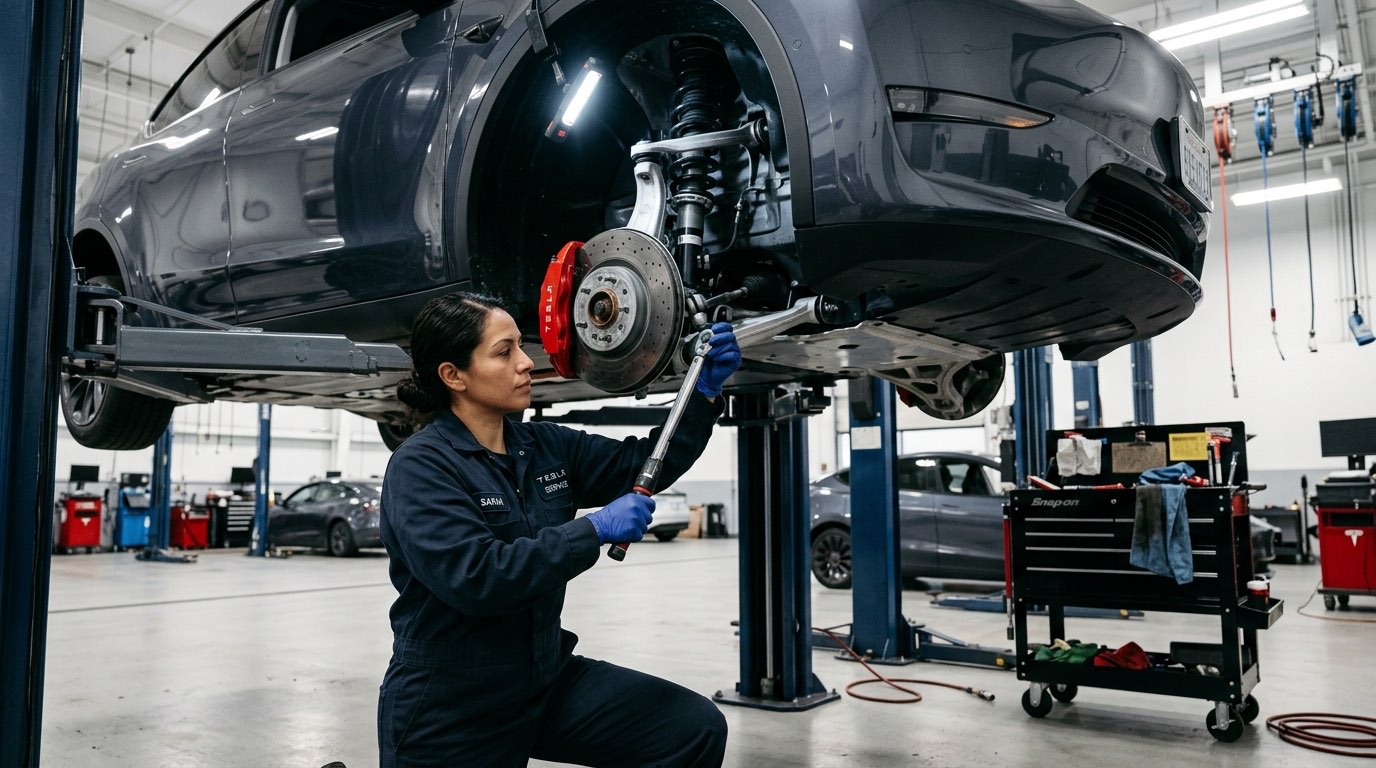
Tesla tires typically last about 20,000–40,000 miles, which is shorter than many gas cars, because Teslas are heavy and deliver instant torque; regular rotation every 6,250 miles, correct pressure and a good alignment are what push you toward the top of that range. Performance models on large wheels and soft summer tires often sit at the bottom.
This Tesla tire guide covers how long tires last on each model, Tesla’s rotation interval, the acoustic foam inside many Tesla tires, alignment and inner-edge wear, TPMS sensors, and how to choose replacements, with typical 2026 US costs.
In short
- Most Tesla owners report roughly 20,000–40,000 miles per set; Performance trims and 20–21 inch wheels wear fastest.
- Tesla’s maintenance schedule says to rotate tires every 6,250 miles (10,000 km) or when tread depth differs by 2/32 in or more.
- Inner-edge wear is common on Model 3 and Model Y and is usually an alignment (camber/toe) issue.
- Choose tires with a load index at or above the original and, ideally, an EV or Tesla-specific (T0) marking.
- Acoustic foam reduces road noise; if it detaches it can cause a highway steering wheel shake.
How long do Tesla tires last?
Tesla tires usually last 20,000–40,000 miles, according to the range most owners report on forums and to tire retailers. Weight is the main reason: a Tesla Model Y Long Range weighs around 4,300 lb, several hundred pounds more than a comparable gas crossover, and electric motors put full torque on the road from a standstill.
Driving style, wheel size and tire type matter more than the model. A Model 3 on 18-inch all-season tires driven gently can exceed 40,000 miles; a Model 3 Performance on 20-inch summer tires may need new tires before 20,000 miles.
| Model / setup | Typical tire life (owner-reported range) | Notes |
|---|---|---|
| Model 3 (18-inch all-season) | 25,000–45,000 miles | Longest-lasting common setup |
| Model 3 Performance (20-inch summer) | 15,000–25,000 miles | Soft compound, high torque |
| Model Y (19–20-inch all-season) | 20,000–35,000 miles | Heavier; watch inner edges |
| Model S / Model X (19–22-inch) | 20,000–35,000 miles | Large wheels and weight; air suspension settings matter |
| Cybertruck (all-terrain) | 25,000–40,000 miles | Heavy truck; follow placard pressure closely |
Hedged owner-reported ranges. Your mileage varies with driving style, alignment and climate.
Tesla tire rotation interval
Tesla’s published maintenance schedule recommends rotating tires every 6,250 miles (10,000 km), or sooner if the tread depth difference between tires reaches 2/32 in (1.5 mm) or more. Rotation evens out wear between front and rear, which is especially important on dual-motor cars where both axles drive.
Most tire shops can rotate a Tesla, but they must lift it on the correct jack points with jack pads to avoid damaging the battery pack. Cars with staggered wheel sizes (wider rears on some Performance and Model S/X setups) can only be rotated side to side if the tires are non-directional, or not at all. Our Tesla maintenance schedule lists the other intervals, and our DIY tool kit covers jack pads.
Acoustic foam and highway vibration
Many original-equipment Tesla tires have a strip of acoustic foam glued inside the tread to cut road noise. These tires usually carry a marking such as “T0” (Tesla-specific), “Acoustic” or a brand term like “Sound Comfort” or “Silent.”
If the foam partly detaches, it shifts inside the tire and throws off the balance. The classic symptom is a steering wheel shake between about 65 and 80 mph that a normal balance does not fix. A shop can dismount the tire, remove the loose foam and Road Force balance it, usually for far less than a new tire. See steering wheel vibration from tire foam and the owner hacks post.
Alignment and inner-edge tire wear
Inner-edge wear is one of the most common tire complaints on Tesla Model 3 and Model Y. It usually comes from camber and toe settings that are at the edge of the factory range, sometimes made worse by worn upper control arms or after the car has been lowered.
Check the inner shoulder of each front tire every few months by running a hand across the tread. If the inside edge is visibly lower, get a four-wheel alignment. A Tesla four-wheel alignment typically costs about $100–$200 at an independent shop and $200–$350 at Tesla, per our alignment guide. A squeak or clunk over bumps alongside uneven wear points to upper control arms.
TPMS on a Tesla
Every Tesla has a tire pressure monitoring system (TPMS) that warns when a tire is significantly below the recommended pressure. Newer models use Bluetooth Low Energy sensors; older Model S and Model X use 315 MHz or 433 MHz sensors depending on year and market. When you buy new wheels, make sure the sensors match your car.
Cold weather is the most common cause of a TPMS warning, since pressure drops about 1 psi per 10°F. After new tires or wheels, the car may need to relearn sensors, which can take a short drive. A sensor that stays faulty usually has a dead internal battery; see the TPMS guide for costs.
How to choose replacement Tesla tires
Choose a replacement tire that matches the size, speed rating and load index on the door pillar placard, then decide between range, grip and noise.
- Load index: match or exceed the original. Many Tesla fitments use XL (extra load) tires, and some EV tires carry HL (high load) ratings for heavier vehicles.
- EV-rated tires: tires designed for EVs typically have low rolling resistance for range, stiffer sidewalls for weight and foam or tuned tread for noise.
- Tesla-specific markings: a T0 or T1 marking shows the tire was developed with Tesla, but non-marked tires of the right size and load index are fine.
- Rolling resistance: low rolling resistance can preserve a few percent of range compared with high-grip tires.
- Noise: tires without foam are cheaper and easier to repair but can be noticeably louder in a quiet EV.
- Treadwear warranty: a 45,000–70,000 mile warranty usually signals a harder compound that lasts longer on a heavy EV.
Tesla tire costs in 2026
These are typical 2026 US price ranges for a Tesla. Quotes vary by region, brand and wheel size; Tesla service centers often charge more than tire retailers.
| Service | Typical 2026 US cost | Notes |
|---|---|---|
| New tire, 18–19 inch (each) | $180–$300 | All-season, installed price varies |
| New tire, 20–21 inch (each) | $250–$450 | Performance and Model S/X sizes |
| Cybertruck tire (each) | $300–$500 | Large all-terrain sizes |
| Full set of four, installed | $800–$1,800 | Includes mounting and balancing |
| Rotation | $25–$60 | Sometimes free with tire purchase |
| Four-wheel alignment | $100–$350 | Independent shop vs Tesla |
| TPMS sensor (each, installed) | $60–$250 | Independent vs Tesla |
| Foam removal and Road Force balance | $15–$30 per tire | For foam-related vibration |
Estimated 2026 US tire costs for Tesla vehicles. Prices vary; get local quotes.
Flat tires and repairs
Most Teslas do not carry a spare tire. Tesla includes or sells a tire repair kit on many models, and roadside assistance can tow you. A foam-lined tire can still be plugged or patched by a shop that removes the foam around the puncture first; some shops decline foam tires, so call ahead. A sidewall puncture always means a new tire. If you are checking a used car, use our used Tesla checklist to inspect tire wear and matching brands.
Frequently asked questions
How long do Tesla tires last?
Most Tesla tires last about 20,000–40,000 miles. Gentle drivers on 18-inch all-season tires can see more, while Performance models on 20-inch or 21-inch summer tires may need replacements before 20,000 miles. Weight, instant torque, alignment and rotation habits are the biggest factors. Rotating every 6,250 miles and keeping correct pressure extends tire life.
How often should I rotate my Tesla tires?
Tesla’s maintenance schedule recommends rotating tires every 6,250 miles (10,000 km), or whenever the difference in tread depth between tires is 2/32 inch (1.5 mm) or more. Cars with staggered wheel sizes have limited rotation options. Make sure the shop lifts the car on the proper jack points using jack pads to protect the battery pack.
Do I have to buy Tesla-branded T0 tires?
No. T0 or T1 markings mean the tire was developed with Tesla, often with acoustic foam, but any tire in the correct size, speed rating and load index is acceptable. Many owners choose EV-specific tires from major brands for a good balance of range, noise and tread life. Always match or exceed the original load index.
Why are my Tesla tires wearing on the inside edge?
Inner-edge wear on Tesla Model 3 and Model Y is usually caused by negative camber and toe settings at the edge of spec, sometimes combined with worn upper control arms. A four-wheel alignment, typically $100–$200 at an independent shop, is the fix. Check the inner shoulders every few months, since the wear is hard to see from outside.
Can a tire with acoustic foam be repaired?
Often yes. A shop has to dismount the tire, cut away a small section of foam around the puncture and apply a patch-plug from the inside. Some tire shops refuse foam tires, so call first. Punctures in the sidewall or shoulder cannot be safely repaired on any tire.
Full repair guide and cost table
Step-by-step fix, tools and Tesla vs. independent shop vs. DIY prices: Tesla Model 3/Y Inner Tire Wear: Alignment Cost Guide.
Tesla Service $200 - $350 (Four-wheel alignment) · independent shop $100 - $200 (Four-wheel alignment) · DIY not recommended
Tesla Model 3 fixes & recalls, by email
One email a month. New fixes, recalls, real prices. Free.
More owner repair stories
- Tesla Service Mode: How to Open It and What to RunThe hidden diagnostics menu every Tesla has, and the four tests worth running.
- How to Reset a Tesla: Soft Reset, Power Off and 12V RebootThree resets, from 15 seconds to 10 minutes. Start with the lightest one.
- Tesla DIY Tool Kit: What You Need (and What Not to Touch)Torx set, jack pads, trim tools. And the jobs you should never do at home.
- Does an Independent Shop Void Your Tesla Warranty?Short answer: no. Here is what the law says and where the limits are.
This guide is for information only. High-voltage components (orange cables) can be lethal — leave them to trained technicians. Not affiliated with Tesla, Inc.